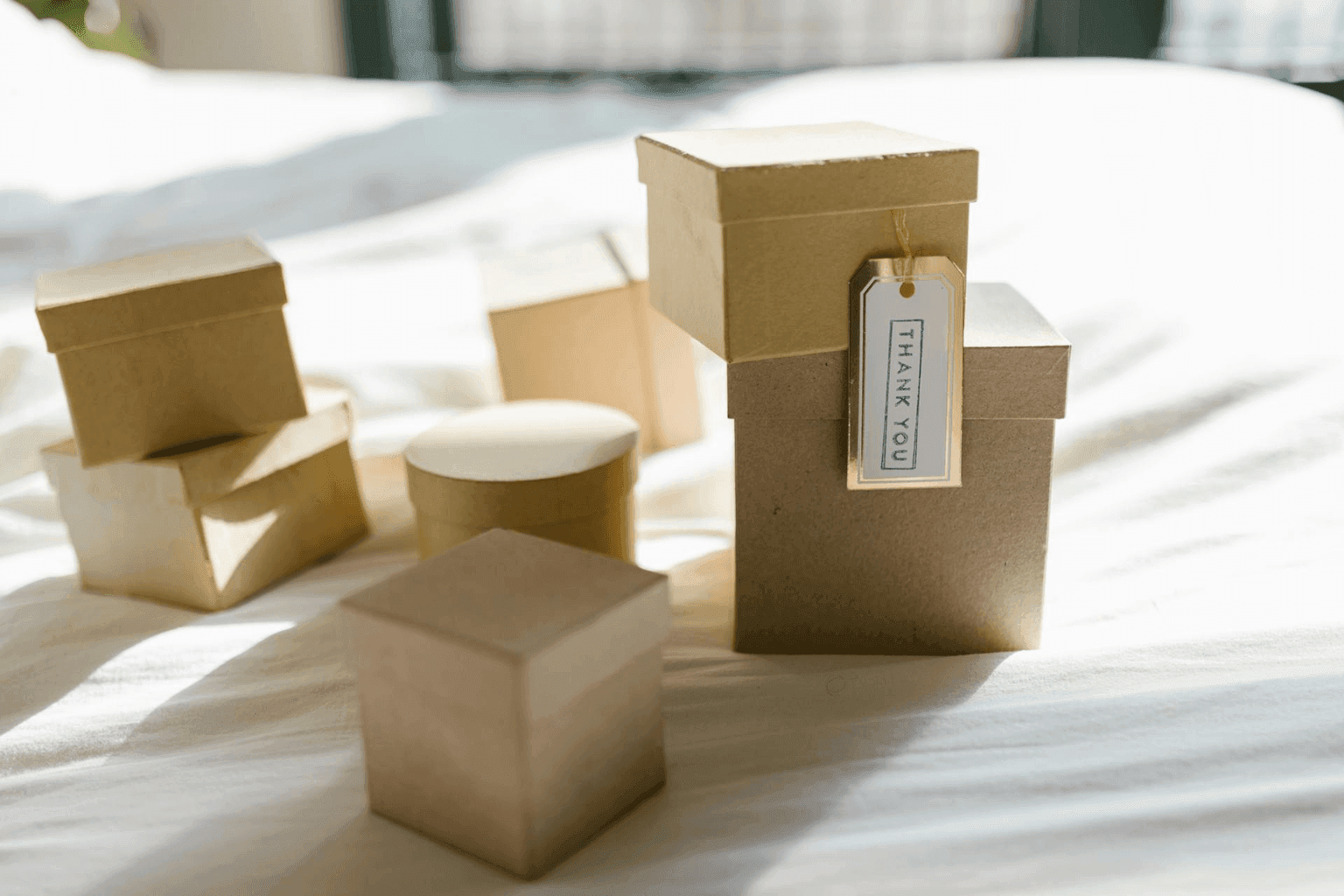
Gift boxes are one of the most profitable bundle types on Shopify. They command a price premium over individual products because the packaging and curation add real value. And they tap into a buying motivation — giving a gift — that's inherently less price-sensitive than shopping for yourself.
Lvly, an Australian flower and gifting brand on Shopify Plus, expanded from just 9 products to over 150 bundled SKUs, achieved a 6% year-over-year AOV increase, and had their biggest Valentine's Day sale ever. They also saved approximately AUD $50,000 in external developer costs by handling bundle creation through their platform. Gift boxes scale — but only if the packaging, timing, and buying experience are right.
Pre-Made Gift Boxes: Start Here
Most gift box sales come from pre-made, curated sets. The reason: people buying gifts are often in a rush, unsure what to get, and looking for someone to make the decision for them. A curated box labeled "For the Coffee Lover" or "New Mom Essentials" does exactly that.
This is the core insight of gift bundling — you're not selling products, you're selling a solved problem. The customer's problem is "I need a gift for [person/occasion]" and your curated box is the complete answer.
By Recipient
For Her / For Him: Broad, reliable, works year-round. Stock these with your bestsellers. These are your always-on gift boxes that don't depend on a calendar.
For Mom / For Dad: Seasonal peaks (Mother's Day, Father's Day) but also relevant for birthdays. Customize the product selection and messaging for the occasion — the same base products with different card inserts can serve both.
For the Host/Hostess: Candles, artisanal snacks, wine accessories, a nice tea towel. The kind of thing someone grabs on the way to a dinner party. Price this box under $40 for impulse purchases.
By Occasion
Birthday Box: Something indulgent — premium chocolate, a scented candle, a small luxury item. Include a birthday card option. This is your highest-volume gift occasion outside of holidays.
Thank You Box: Thoughtful, not extravagant. Cookies, tea, a handwritten-style card. Appropriate for a client, a coworker, or someone who helped you move. Corporate gifting potential here — many businesses buy thank-you boxes in bulk.
New Baby Box: Practical meets charming — a onesie, a small stuffed animal, something for the parents (coffee, a sleep mask, snacks). The "something for the parents" part differentiates this from every baby-only gift box on the market.
Holiday Box: Your Q4 star. Festive flavors, seasonal items, premium packaging. This box should feel like an event, not just a purchase.
By Interest
The Coffee Lover: Whole bean coffee, a mug, biscotti, chocolate-covered espresso beans. One of the most universally giftable themes.
The Wellness Box: Bath salts, a face mask, a candle, herbal tea. The self-care trend makes this a year-round seller, not just holidays.
The Foodie Box: Artisanal olive oil, fancy salt, truffle honey, crackers. Premium food gifts work because they're consumable — they don't create clutter.
Start with 3-5 pre-made boxes. Too many options overwhelm gift buyers who are already uncertain about what to pick. You can add more based on sales data once you see which themes resonate.
Build-Your-Own Gift Boxes
Some customers want to customize. A build-your-own option lets them pick a box size and fill it with their choice of products from a curated selection.
This is more complex to set up but serves the customer who wants personalization:
Box sizes: Small (3 items), Medium (5 items), Large (7 items). Fixed sizes with fixed pricing are simpler to manage than dynamic pricing based on selected items.
Eligible products: Not everything in your store — a curated list of items that fit physically in the box and make sense as gifts. Including a 2-pound ceramic mug alongside delicate chocolate truffles is asking for broken items.
Default selections: Show a "Staff Picks" or "Most Popular" pre-filled selection in the build-your-own interface. Many customers will stick with the defaults or make minor changes, which saves them time and gives you some control over the experience.
A bundle app like Buno handles the build-your-own logic, letting customers select from eligible products up to a set limit with individual inventory syncing. This is far easier than hacking it through Shopify's native variant system, which hits the 100-variant limit fast when you have dozens of possible product combinations.
One important expectation: pre-made boxes will outsell build-your-own by a wide margin for most stores. Gift buyers want curation, not decisions. The build-your-own option serves a smaller segment and shouldn't be your first priority.
Making Gift Boxes Look Premium
You don't need custom embossed boxes from a specialty manufacturer. Here's what works at each price tier:
The $3-4 Tier (works for most stores)
| Component | Cost | Notes |
|---|---|---|
| Kraft or white mailer box | $1.00-1.50 | Clean, simple, brandable with sticker |
| Crinkle-cut paper fill | $0.30-0.50 | Brand-appropriate color |
| Branded sticker to seal | $0.15-0.25 | Your logo, simple and clean |
| Printed thank-you card | $0.20-0.30 | Heavy card stock, not copy paper |
| Tissue paper wrapping | $0.30-0.50 | Wrap each item individually |
Total: $1.95-3.05 per box. This creates a legitimate gift experience for boxes priced at $40-60.
The $6-8 Tier (premium positioning)
| Component | Cost | Notes |
|---|---|---|
| Rigid gift box with magnetic closure | $2.50-4.00 | The unboxing moment |
| Satin ribbon | $0.50-0.75 | Color-matched to brand |
| Branded card on heavy stock | $0.40-0.60 | Product descriptions or story |
| Tissue paper and crinkle fill | $0.50-0.75 | Layered presentation |
| Extra touch (recipe card, care instructions) | $0.20-0.30 | Adds perceived thoughtfulness |
Total: $4.10-6.40 per box. For boxes priced at $75-120+. The magnetic closure box alone elevates the unboxing experience dramatically.
Both tiers create a real gift experience. Match the packaging to your price point — a $40 box in a $6 rigid box eats margins; a $100 box in a $2 kraft box feels cheap.
Pricing Gift Boxes
Gift box pricing works differently from regular bundle pricing because you're adding value through curation and presentation, not just grouping products at a discount.
The formula:
Gift Box Price = (Sum of individual prices) - (5-10% product discount) + (packaging cost) + (curation premium)
The curation premium is real — you're doing the work of selecting, styling, and packaging. Typically $3-8 depending on the price tier.
Example: Three products at $18, $22, and $15 individually ($55 total). Packaging costs $4. Apply a 10% product discount ($5.50 off). Add a $3 curation premium.
Gift box price: $55 - $5.50 + $4 + $3 = $56.50, which you'd round to $57.
The customer sees a gift box at $57 that contains $55 worth of products plus premium packaging. The perceived value exceeds the price because the packaging and curation add tangible worth the customer would have to replicate themselves — finding a box, buying fill, arranging everything, writing a card.
For premium gift boxes ($100+): You can reduce or eliminate the product discount entirely. At higher price points, the curation and presentation are the value proposition, not savings. A $120 gift box with $110 worth of products in gorgeous packaging doesn't need a discount to feel worthwhile.
The Gift Message and Direct-to-Recipient Experience
A gift box that ships to the buyer and then has to be re-wrapped and re-shipped defeats the purpose. Make direct-to-recipient gifting seamless.
Checkout Experience
- Add a "This is a gift" checkbox (Shopify supports this natively)
- Provide a gift message text field (150-200 characters is plenty)
- Let the buyer enter a separate shipping address for the recipient
- Offer a date-specific delivery option if your fulfillment can support it
Packing Process
Never include pricing information in gift shipments. No invoices, no packing slips with dollar amounts. This is the most common mistake and the one that ruins the gift experience.
- Print the gift message on a card and include it in the box
- Use a "Gift enclosed" sticker on the outer shipping box
- Consider a branded outer sleeve so even the shipping box looks intentional
- Remove or cover any price tags on individual items
Test this by ordering a gift box shipped to your own address. Go through the entire experience as a recipient: see the shipping box, open it, find the card, discover the products. If anything feels off — a price tag attached, a packing slip with costs, cheap filler scattered everywhere — fix it before launch.
Seasonal Planning Calendar
Gift boxes have strong seasonal peaks. The key is launching early enough and promoting shipping deadlines aggressively.
| Month | Opportunity | Launch Timing |
|---|---|---|
| January | New Year / self-care boxes (gift-to-yourself) | Early January |
| February | Valentine's Day | Mid-January (4-5 weeks before) |
| March-April | Easter, Mother's Day prep | Mother's Day boxes by mid-March |
| May | Mother's Day, Teacher Appreciation | Final push first week of May |
| June | Father's Day, wedding season, bridal gifts | Early May |
| July-August | Low demand — photograph and plan Q4 boxes | Use this time for production |
| September | Back-to-school teacher gifts | Early September |
| October | Halloween-themed boxes, early holiday soft launch | Early October for holiday preview |
| November | Full holiday launch, BFCM promotions | November 1 (hard launch) |
| December | Last-chance holiday ordering | Push shipping deadlines hard |
After your shipping cutoff date (typically December 15-18 for Christmas), pivot to digital gift cards with a message like "Missed the shipping window? Send a gift card and we'll ship a gift box in January." This captures late shoppers who would otherwise leave empty-handed.
Half of holiday gift box sales happen in the final two weeks before the shipping deadline. Plan your inventory accordingly — running out of your most popular gift box on December 8 means missing the biggest sales window.
Corporate and Bulk Gifting
This is an underserved opportunity for most Shopify stores. Businesses buy gifts in bulk — for clients, employees, event attendees — and they want a simple process with consistent quality.
Create a "Corporate Gifting" page with:
- Your gift box options with bulk pricing (5-10% discount on 10+ units, 10-15% on 25+)
- A custom branding option (branded card insert with the company's logo and message)
- An inquiry form for large orders
- Expected turnaround times for bulk orders
Corporate orders have larger AOV, are less price-sensitive, and often repeat annually. A company that orders 50 holiday gift boxes this year will likely order 50-75 next year if the experience was good.
Setting Up on Shopify
Create each gift box as a bundle using Buno so inventory tracks at the individual product level. A candle that appears in three different gift boxes and is also sold individually needs accurate stock counts across all listings.
Add a "Gift Boxes" or "Gift Sets" collection to your main navigation — don't bury it in a dropdown. During peak gifting season (November-December), feature gift boxes prominently on your homepage. Consider a dedicated landing page for holiday gifting with a simple decision framework: recipient type, budget range, occasion.
Start with 3 pre-made boxes at different price points (under $40, $40-70, over $70). Track sales for 30 days. Pay attention to which boxes get views but don't convert — that usually means the price or the product selection needs adjustment, not that the concept is wrong. Add a build-your-own option only after your pre-made boxes are validated and selling consistently.